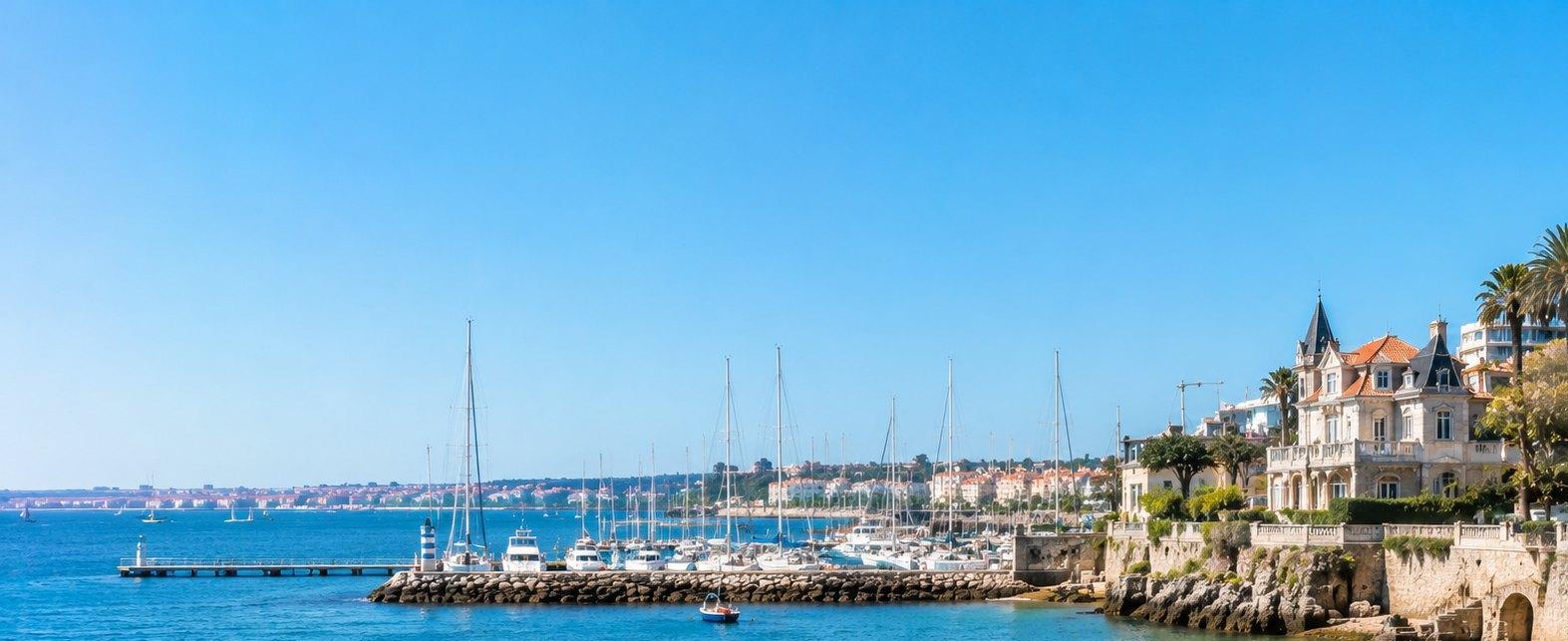

Living in Cascais means trading the noise of central Lisbon for the sound of the Atlantic, and for international families buying at the top of the market that is usually the whole point. The two towns sit on the coast west of the capital, close enough for a lunch in Chiado or an early flight out of Lisbon, and far enough to feel like a different life. Estoril comes first along the shore, grander and quieter, with large villas and wide gardens. Cascais follows, a former fishing town turned royal summer retreat, with a marina, an old centre, and beaches right below the town. Buyers come out here expecting a smart suburb and find something closer to a small seaside town with old money, golf, and a European capital half an hour away.
Key takeaways
- Cascais and Estoril sit on the Atlantic coast west of Lisbon, linked to the city by the A5 motorway and the coastal Marginal road.
- The climate is mild and Atlantic, breezy on the coast, not Mediterranean-still. Typical climate figures: average daytime highs range from about 14°C in January to 28°C in August, while average lows range from about 8°C in January to 18°C in August. Rain is concentrated from October to April, with July and August especially dry. These figures are nearby Lisbon-area climate averages rather than a dedicated Cascais weather station.
- Estoril is quieter and more residential; Cascais has the marina, the old town, and more going on.
- The most sought-after addresses include Quinta da Marinha, Birre, Monte Estoril and the villa streets of Estoril.
- The area draws international families, partly for its international schools. Examples of international schools in the area include SAIS (Santo António International School), which offers a Cambridge pathway from ages 2 to 19 in Monte Estoril; Prime School Estoril, offering Cambridge education from ages 3 to 18; and IPS Cascais British International School, which offers the English National Curriculum. These are private schools with their own admissions processes, not state-school catchments; availability, entry requirements and transport should be checked directly with each school.
- The honest trade-offs are cold ocean water, summer traffic on the coast road, and a limited supply of prime homes.
Getting to Lisbon and the airport
The A5 motorway is the quick route both into Lisbon and out to Humberto Delgado Airport. Central Lisbon is roughly 30 to 40 minutes away, and the airport about half an hour by car, depending on traffic. Closer to home you often need no car at all, because the centres of Cascais and Estoril are flat and walkable. For anyone who travels often, that short airport run is a large part of the appeal, because an early flight does not have to begin with a night in a city hotel.
The Marginal is the other way in, a slower road that hugs the water past Carcavelos and Estoril. Out of season it is one of the most pleasant drives around Lisbon. In July and August it clogs badly, and residents who know the coast take the A5 instead or plan their day around the traffic. For evenings in the city, a car with a driver is the easy answer, since parking in Lisbon’s historic centre is a test of patience.
Where prime buyers look on the coast
The coast is not one market, and the best addresses sit in a handful of distinct pockets. Quinta da Marinha, west of Cascais towards Guincho, is gated, resort-style living: detached villas set around golf courses and pine forest, chosen for privacy and security. Birre, just inland from Cascais, is quieter and lower in density, with large contemporary villas on generous plots that suit families. Monte Estoril climbs the hillside between the two towns, with sea-view apartments and restored period villas.
Each pocket lives differently. Quinta da Marinha gives you space and seclusion a short drive from Cascais town, while Monte Estoril keeps you close to the seafront promenade and the cafés, usually on a smaller plot or in an apartment. Some of the best homes in these areas change hands privately, without ever appearing on a public portal. Our Cascais and Estoril area guide covers the area in more detail.
Cascais, the old fishing town
Cascais is the livelier of the two towns, and it is lived in all year, by Portuguese families and long-settled international residents alike. It grew from a fishing village into a royal summer retreat in the nineteenth century, and you can still read both histories in the streets: the working harbour and fish auction on one side, the old aristocratic villas and the Cidadela fortress on the other. The centre is walkable and low, with a cluster of small beaches like Praia da Rainha and Praia da Conceição tucked right below the town, and the Mercado da Vila for produce and a slower Saturday.
The marina sits beside the old town, so for anyone who keeps a boat, the berth and the morning coffee are a short walk apart.
Out past the town the coast turns wild. Praia do Guincho, inside the Sintra-Cascais Natural Park, faces the open Atlantic and the wind that comes with it, which is why it is a surfing and kitesurfing beach rather than a place to doze on a towel. The dunes, the Serra de Sintra behind, and the Boca do Inferno cliffs a short walk from the marina remind you that the ocean here is powerful, not decorative. For a rainy afternoon there is the Casa das Histórias Paula Rego and the Santa Marta lighthouse museum, both a short walk from the centre.
Estoril, quieter and grander
Estoril sits just east of Cascais and trades some of the bustle for space and calm. It is best known for the Casino Estoril, one of the largest in Europe, and for the exiled European royalty and wartime émigrés who settled here in the 1930s and 40s. That history left the town with grand villas, wide gardens, older money, and a more residential feel than its neighbour. The beach at Tamariz sits right below the casino gardens, sheltered enough for a family swim on a calm day.
The seafront promenade, the Paredão, links Estoril to Cascais along the water, a walkable stretch that fills with runners, cyclists, dog-walkers, and families most mornings. Estoril also carries a long golf tradition, with championship courses around Quinta da Marinha and Estoril itself, which is part of why the town draws retirees and second-home owners who want the coast without the crowds of central Cascais. The trade-off is that Estoril is quieter in the evenings, and some visitors find it a little sleepy, which is exactly why others choose it.
What daily life actually feels like
Daily life on this coast is organised around the water and the weather far more than around the calendar. Mornings on the Paredão are a local institution, and by mid-morning the cafés along the seafront are full. Weekends run on golf, the beaches, the marina, the Saturday market, and long lunches that drift into the afternoon.
The international community is large and settled rather than transient. You see it in the number of international schools in and around the area, in the private hospitals and clinics that serve the coast, and in how easy it is to get by in English while you learn Portuguese.
The seasons matter more than newcomers expect. Summer is bright and busy, the beaches are full, and the towns take on a holiday energy. Winter is mild but properly Atlantic, with grey stretches and some damp in older houses. The pace slows, but the coast does not empty: the international community lives here year-round, and the marina, the golf courses, the cafés and the town centres stay in use. On a clear February morning the promenade belongs mostly to runners and dog-walkers, and by August you queue for a table at the same café. It is worth spending time here in both seasons before deciding.
The honest trade-offs
The coast has real drawbacks, and it is better to know them before you fall for the view. The first is the water: this is the Atlantic, not the Mediterranean, and the ocean stays cold through the year, so swimming is bracing even in August and the wind at Guincho can end a beach day early. The second is summer traffic. The Marginal and the roads into Cascais clog badly in July and August, and what is a short drive in winter becomes a slow crawl.
The third is supply. With the Atlantic to the south and west and the protected Sintra-Cascais Natural Park to the north, new building land is strictly capped, so the homes most buyers want (villas with sea views, gardens, and real privacy) are few, and they are priced accordingly. Some of them change hands privately and never reach the open market. For current figures, our Lisbon property prices in 2026 guide sets out the numbers across the region. None of this makes the coast a bad choice. It just means the honest version includes cold water, August traffic, and a small pool of prime homes alongside the mornings on the Paredão.
Cascais and Estoril versus central Lisbon
The real choice between the coast and central Lisbon comes down to what you want your ordinary week to look like. Central Lisbon gives you the museums, the restaurants, the walkable historic parishes, and the option of a fine apartment in Chiado or Príncipe Real. Cascais and Estoril give you the ocean, a villa with a garden, golf, the marina, and quieter streets, at the cost of a drive into the city and a slower evening scene.
For families the calculation often tips toward the coast, because of the schools, the beaches, and the space. Buyers who want culture on their doorstep usually lean toward the city, and our guide to the best neighbourhoods in Lisbon covers those inner-city options in depth. The choice does not have to be one or the other: some buyers keep a city apartment for the week and a coastal home for weekends and summers, and the distance between the two is short enough to make that work. Either way, spend a normal week in each, not a holiday, and see which one you are reluctant to leave.
Frequently asked questions
Is Cascais a good place to live?
Cascais suits buyers who want coastal living within reach of a capital city: beaches, a walkable old town, a marina, golf, and a large, settled international community. It works especially well for families, thanks to the international schools and outdoor lifestyle, and for second-home owners who want a base close to Lisbon’s airport. The main trade-offs are cold Atlantic water, heavy summer traffic, and a limited supply of prime homes.
How far is Cascais from central Lisbon?
Cascais is roughly 30 to 40 minutes from central Lisbon by car via the A5 motorway in normal traffic, and Humberto Delgado Airport is about half an hour away, depending on traffic. The Marginal coast road is the slower, scenic alternative past Carcavelos and Estoril. Both routes slow down considerably in July and August, so it pays to plan trips around peak summer traffic.
Cascais or Estoril: which one suits you?
Estoril is quieter, more residential, and a little grander, known for its casino, gardens, and golf, and popular with retirees and second-home owners. Cascais is livelier and has the marina, the old town, and easier access to wild beaches like Guincho. The two towns are linked by the Paredão seafront promenade, so many residents use both regardless of where they live.
What are the most exclusive areas of Cascais?
The most sought-after addresses include Quinta da Marinha, a gated area of villas around golf courses and pine forest west of the town; Birre, a low-density area of large contemporary villas; Monte Estoril, with sea-view apartments and restored period villas; and the older villa streets of Estoril. Each has its own character and price tier, so it is worth comparing them street by street before buying.
Is Cascais expensive to live in?
The western coast is one of the most expensive areas around Lisbon, and its prime pockets sit at the top of the regional market. Sea views, plot size, privacy, and proximity to international schools all add a premium, and the supply of prime homes is limited by the ocean and the protected natural park. Prices vary widely by street and property type, so recent comparable sales are more useful than a town-wide average.
Finding the right spot on the coast
Cascais and Estoril reward buyers who want the ocean, more room, and a slower week, and who are happy to trade a little of Lisbon’s cultural intensity for it. The coast is not a single place: the gated quiet of Quinta da Marinha, the villa streets of Estoril, the sea-view hillside of Monte Estoril, and the busy heart of Cascais are genuinely different lives, and the right one depends on how you actually spend your days.
If you are weighing the western coast against central Lisbon, the most valuable step is having someone who knows both walk the specific streets with your priorities in mind, including the homes that are sold quietly rather than listed. To talk through where you would actually fit on this coast, with a buyer’s agent who represents you and never the seller, book a private consultation at lisbonba.com/contact.